SEO Basics: Keywords 101

Updated by
Updated on Jan 19, 2026
Search engine optimization (SEO) starts with one essential concept: keywords. Understanding what keywords are, how they work, and how to research them is the foundation of any successful SEO strategy.
This guide will walk you through SEO basics, including keyword types, search intent, keyword organization, and how to prioritize keywords to drive meaningful organic traffic.
What Are Keywords?
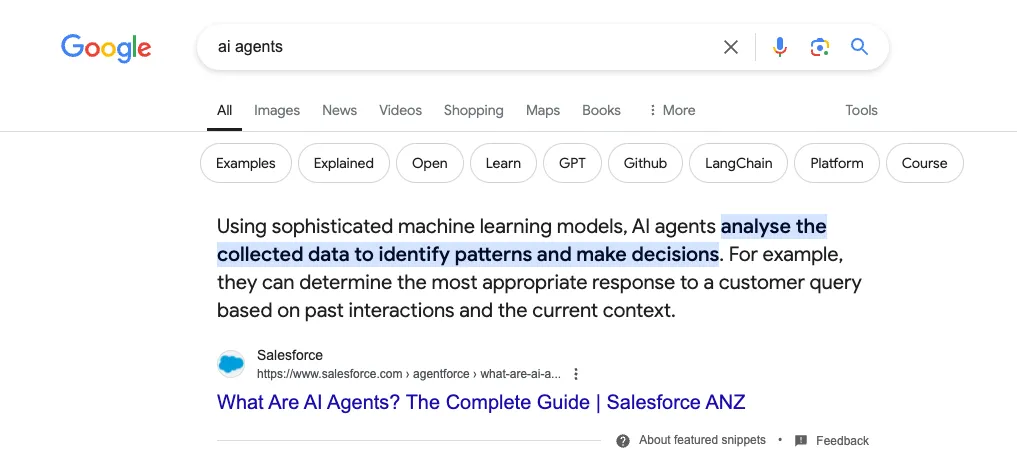
Keywords (often called SEO keywords) are the words or phrases that people type into search engines like Google when looking for information, products, or services.
For example, when someone searches for “AI agents”, that phrase is a keyword. Search engines analyze this keyword and display the most relevant results on the Search Engine Results Page (SERP).
In many cases, Google may display a featured snippet—a short, direct answer extracted from a well-optimized webpage that closely matches the user’s query.
Primary Keywords and Semantic Keywords
In SEO, content is usually optimized around more than one keyword.
Primary Keyword
The primary keyword is the main topic of a page. It typically has the highest search volume and represents the core subject of the content.
Example:
- Primary keyword: AI agents
Semantic Keywords (Related Keywords)
Semantic keywords are closely related phrases that support the primary keyword and help search engines better understand the topic.
Examples:
- What are AI agents?
- AI agent definition
- How do AI agents work?
SEO professionals typically optimize one page around one primary keyword and multiple semantic keywords, allowing the page to rank for a cluster of related search terms rather than just one.
Keyword Clusters and Ranking Potential
One important SEO principle is that a single page can rank for many keywords.
Using tools like Ahrefs or Semrush, you can analyze a ranking page and see all the keywords it is indexed for. Often, a strong page ranks for hundreds of related keywords, even if it was written with only one main keyword in mind.
This means you do not need to create a separate page for every keyword. Instead, you should build comprehensive content that naturally covers related terms.
Types of Keywords
Keywords generally fall into two main categories:
Short-Tail Keywords
- Usually 1–2 words
- Broad and generic
- High search volume
- High competition
Examples:
- SEO
- Running shoes
- Digital marketing
Short-tail keywords can bring large amounts of traffic, but they are difficult to rank for, especially for new websites.
Long-Tail Keywords
- Three words or more
- More specific
- Lower search volume
- Lower competition
Examples:
- Keyword research for beginners
- Best running shoes for concrete roads
- Small living room furniture ideas
Although long-tail keywords attract less traffic individually, they are much easier to rank for and often convert better because they reflect clearer user intent.
A balanced SEO strategy usually includes both short-tail and long-tail keywords.
Understanding Search Intent
Search intent refers to why a user performs a search. Understanding intent is critical because Google prioritizes results that best satisfy the user’s goal.
There are four main types of search intent:
-
Informational
Users want to learn something.- “What is keyword research?”
- “How to clean an oven”
-
Navigational
Users want to reach a specific website or brand.- “Gmail login”
- “Salesforce CRM”
-
Commercial Investigation
Users are comparing options before making a decision.- “Best dog food in 2024”
- “iPhone vs Samsung”
-
Transactional
Users are ready to take action.- “Buy Nike running shoes”
- “Netflix subscription”
Your content should match the search intent of the keyword you are targeting. If the intent is informational, your content should educate—not sell.
Why Keyword Research Is Important
Keyword research helps you understand what your audience is actually searching for, instead of guessing.
Without keyword research:
- You may target keywords with no real demand
- Or target keywords that are too competitive to rank for
Effective keyword research helps you find the right balance between:
- Search volume
- Keyword difficulty
- Relevance to your business
- User intent
Websites that rank at the top of Google receive a significantly higher percentage of clicks, which makes keyword research a critical driver of organic traffic.
Organizing Keywords Effectively
A practical way to manage keywords is to group them by search intent and topic, often using a spreadsheet.
Example:
Informational Intent
- Running shoes (seed keyword)
- How long do running shoes last?
- When should you replace running shoes?
Commercial Intent
- Women’s running shoes
- Men’s running shoes
- Carbon plate running shoes
This approach allows you to target users at every stage of the buyer journey, from learning to purchasing.
How to Prioritize Keywords
There is no single “correct” way to prioritize keywords, but these factors can guide your decisions:
- Relevance: Does the keyword align with your product, service, or audience?
- Keyword Difficulty: Beginners should focus on lower-difficulty keywords first.
- Search Intent: Informational keywords build authority; transactional keywords drive conversions.
- Audience Understanding: The better you know your audience, the easier it is to choose valuable keywords.
Local and Regional Keyword Considerations
Keywords vary significantly by region. A keyword that performs well in one country may not work in another.
For example, technology-focused markets like Singapore may favor:
- Highly technical keywords
- Niche product features
- Premium-focused search terms
Most SEO tools allow you to adjust the target country or region, which is essential for effective local keyword research.
Conclusion
SEO success begins with understanding keywords.
By researching what your audience searches for, organizing keywords into meaningful clusters, and aligning content with search intent, you can create pages that rank higher and attract consistent organic traffic.
Use tools like Ahrefs or Semrush to analyze search volume, keyword difficulty, and intent. Focus on value, not just traffic numbers. Over time, a strong keyword strategy will help you build authority, visibility, and long-term growth.
About the Author
Updated by
Richard
Richard is a technical SEO and AI specialist with a strong foundation in computer science and data analytics. Over the past 3 years, he has worked on GEO, AI-driven search strategies, and LLM applications, developing proprietary GEO methods that turn complex data and generative AI signals into actionable insights. His work has helped brands significantly improve digital visibility and performance across AI-powered search and discovery platforms.
